
Movie Review: Oversabi Aunty and the Cost of Emotional Neglect
Over the weekend, I went to the cinema to watch Toyin Abraham’s latest project, Oversabi Aunty. I had been seeing a series of raves from fans highlighting the emotional feel of the film. I was curious because, prior to those reviews, I would have thought it was just a comic blockbuster, especially considering Toyin’s funny portrayal of the character in Iyabo Ojo’s Instagram comments and during Iyabo Ojo’s daughter’s wedding.
Oversabi aunty meaning
Oversabi Aunty means a middle-aged woman who is excessively involved in other people’s affairs and lives at the detriment of her own. It can also have a positive meaning, as the aunty who goes around with her busybody ways during your events—in slippers, sweaty face, and lopsided gele—to ensure everything goes smoothly. Oversabi aunties can be endearing and annoying; they will fix your bra straps inside danfo buses without you asking them to.
Now, before I go into my review, I would like to start with a background. In 2013, shortly after I gained admission into uni, I became a diehard Toyin Abraham fan. This happened during the release of Alakada Part 1. When Part 2 was released, I initiated my roommate at the time, and ensured she became a fan too. I would watch and rewatch Alakada 1 and 2 to the point where I knew all the lines by heart. In fact, Alakada Part 2, or the Modern Family series especially, became my comfort watch whenever I needed some form of escape.
However, being a diehard fan did not make Toyin immune to my criticism, especially with some of her releases which I felt were below par. An example was Ijakumo, which I enjoyed at the beginning, only to start wondering what was going on in the middle and then getting utterly befuddled at the end.
Enough story. Back to Oversabi Aunty.
I got to the cinema at exactly 2pm, thinking I was minutes ahead of the 2:20pm showing. Imagine my surprise when I was told the movie was sold out! I blamed myself for not buying the ticket online the moment I saw it and wondered why I expected to buy it at the counter in the first place. Anyways, the next showing was also sold out, so I had to wait till evening for the next available time.
At this point, I was intrigued already and extra eager to experience what everyone must have seen. I walked around the mall, people-watched, and doom-scrolled on TikTok. Five minutes to showtime, I walked back to the cinema and at this point, the security couldn’t let us in because the hall was still occupied. I ended up waiting for over 20 minutes as other overexcited fans joined, all of us wondering why we couldn’t enter. Anyways, we eventually went in about 10 minutes after the slated time. Toyin’s army, we move. Lmao.
STRONG START
The movie started strongly with a prompt introduction to the character in her full form. I liked that. We were able to see her nuances right from the start. It also gave insight into the family and the central theme of the movie from the very first scene. I really loved how Efe Irele convincingly played the frustrated older daughter in that opening scene. The chaos!
Even as a non-Christian, I could relate to how exhausted everyone must have felt after leaving church and still having to wait endlessly as Oversabi Aunty, their mum, did her thing.
RELEVANT THEMATIC FOCUS
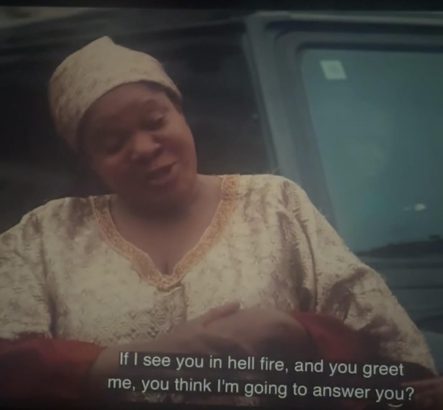
The film did a deep dive into a series of themes that are often neglected in Nollywood movies. Mental health and the repercussions of trauma are central themes in the film, and that was refreshing. Children’s voices were constantly stifled, with Oversabi Aunty repeatedly telling them to pray all their problems away. There was also a father who was too exhausted by his wife’s antics to even be mentally present for his kids.
Best in Religion
Toun, aka Oversabi Aunty, was too fixated on “what will people say” over actually listening to her children. And when one of the repercussions manifested in her youngest child, all she did was hide it away and continue with her self-righteousness and Bible-thumping.
COMEDY
Deeply hilarious! Toyin really passed STRONG, VITAL messages alongside the comedy. The whole cinema started laughing right from the first scene. The dynamics between Toun and her husband, Chidi, were spot on. The exhausting arguments and shouting over the simplest things, and how they both turned on anyone who tried to meddle in their affairs, were very much giving Ojuelegba Romeo and Juliet.
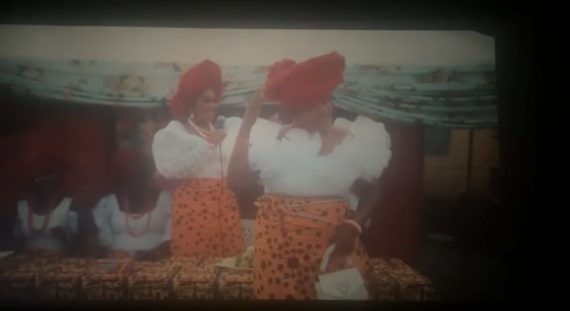
Toyin also used comedy to portray other serious societal issues like intertribal tension. The scene depicting Toun’s eldest daughter’s engagement was chaotic, and rightfully so. Everybody wanted to have a say, with complete disregard for the children whose future was being decided.
Mood: Dancing moro while my daughter is in shambles emotionally
When Aderonke Chioma, aka CHIRO, the Gen Z babe, told her flabbergasted father that her short gown is called the Ayra Starr “look what a hot body can do,” everybody erupted in laughter.
JUXTAPOSITION
In the two instances of deep trauma affecting her children, Toun was busy elsewhere dancing and policing other people’s children. If this was intentional by the movie director, whom I later found out is Toyin herself, then it was brilliant. It succinctly solidified the Falana gbóti proverb. Toun was busy running around and catering to other people’s children while hers were suffering.
PERFORMANCE, CHEMISTRY, AND TONE
Toyin Abraham and Mike Ezuruonye’s chemistry elevated the narrative. Everybody brought their A-game. From Queen Nwokoye to Enioluwa Adeoluwa, I was mesmerized.
ENDING
The ending was satisfying. I loved the buildup and how everyone wondered what Chuka’s fate would be. I like how we got to see why she was too fixated on her children praying and why she yells a lot. And it took rebellion for her to accept how she is harming everyone around her while being oblivious to it all.
Funny enough, I predicted the ending wrongly and I liked the surprise of it all. I loved how Oversabi Aunty accepted her role in how her children’s lives turned out and chose to redeem herself by making the greatest sacrifice ever. The story closed with her eventual self-sacrifice, suggesting accountability and the painful cost of delayed awareness.
POSITIVE PORTRAYAL OF NIGERIAN FORCES
Toyin! God bless you. I have always said that we have had enough of the realism of the “₦20 bribe-collecting policeman” and more of the unrealistic upright police officer. Soft propaganda? Let us do it! Who knows, maybe an anyhow policeman somewhere would see it and be inspired.
The police and traffic officer characters were upright. Even though the traffic officer was a comic character, he was still unflinching in his resolve to penalize them for speeding and not keeping to traffic regulations. Thumbs up, T!
NARRATIVE GAPS
They were minor, but not unnoticeable. We didn’t see anything relating to Chidi’s family after the introduction scene. We only saw his sister, Rose, having altercations with Toun’s brother and Chidi, and then poof. We also barely saw anything about Toun’s family. Chidi mentioned that Toun inherited her shouting nature from her mother, and it would have been nice to actually see how that dynamic played out.
It was also jarring that Toun’s first August meeting as a Yoruba woman, happily married to an Igbo man for eons, comes after her daughter’s introduction to be married. So how have you integrated into his culture, considering he is obviously integrated into hers, with his minor understanding of Yoruba, which he often dilutes with Igbo, something that was often hilarious!
Lol, then there was the product placement in the club scene. But honestly, I don’t think it’s easy to insert product adverts into a movie in a subtle way, so I’ll give that a pass.
None of these gaps undermined the film’s emotional core. I really felt it, and I hated the fact that Toyin Abraham made my eyes misty. Thank God I was wearing my glasses. It was a touching movie. I really enjoyed it, and honestly, I might just go back to the cinema and buy a ticket to watch it again.
YES. IT WAS THAT GOOD.
- Rediscovery: A Reflection on Blogging, Growth, and Self-Betrayal
- When did Ready-To-Wear Fashion in Nigeria become a Luxury Scam?
- Stupid Problems: The Everday Struggles That Hold Nigerians Back
- WHO KILLED BABA KAREEMU?
- Unmute Yourself: Speak, Take Up Space and Disrupt
- Soft Underbelly: The House That Swallowed Them Whole
- Maradona and Nigeria’s Never-Ending Dance of Despair and Deception
- The Gospel of the Nigerian Police According to Sergeant Itoro
- From Natasha Akpoti to Sophia Egbueje: The Many Layers of Misogny
- Folake, When Will You Marry?